

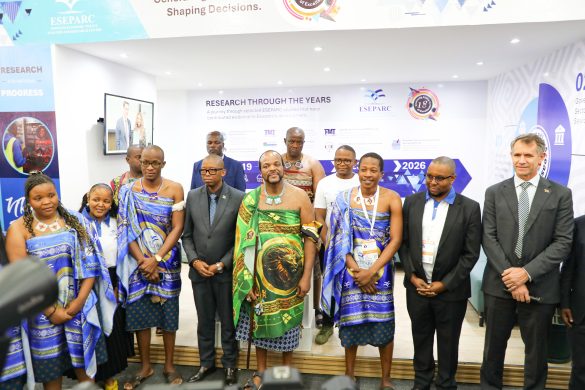
His Majesty King Mswati III Visits the ESEPARC Stand at EITF 2026
ESEPARC had the honour of welcoming His Majesty King Mswati III to its stand during the official opening of the Eswatini International Trade Fair (EITF) 2026. His Majesty was welcomed by the Minister of Finance, Hon. Neal Rijkenberg; ESEPARC Board Chairman, Dr A.S. Metfula; Senior…
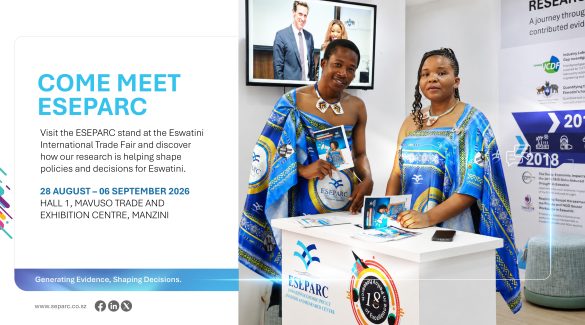
COME MEET ESEPARC
Come meet ESEPARC at the Eswatini International Trade Fair 2026! Visit us in Hall 1 and discover our research, engage with our team, and learn more about the work we do.

Why emaSwati Travel Less at Home, And What Must Change to Unlock Domestic Tourism
“Many emaSwati want to travel locally, but cost, limited information, and access continue to hold them back.” Eswatini has no shortage of beautiful landscapes and scenery, yet domestic tourism remains underutilised and largely occasional. The 2026 Domestic Tourism Study, commissioned by the Eswatini Tourism Authority…

ESEPARC Board of Directors Engage Staff in Meet and Greet Session
The Eswatini Economic Policy Analysis and Research Centre (ESEPARC) recently welcomed members of the Board of Directors for a meet-and-greet session with staff, providing a valuable opportunity for interaction and reflection on the Centre’s ongoing work and future direction. The engagement created a platform for…

ESEPARC Welcomes Interns from UNESWA
The Eswatini Economic Policy Analysis and Research Centre (ESEPARC) is pleased to welcome four students from the University of Eswatini (UNESWA), Faculty of Agriculture, who joined the Centre on 2 March 2026 for a three-month internship programme. The students, who are currently pursuing studies in…

Stakeholders Advance Discussions on the National 4IR & 5IR Strategy
Day two of the stakeholder engagement on the National Fourth and Fifth Industrial Revolution (4IR & 5IR) Strategy and the review of the National Science, Technology and Innovation (STI) Policy continued with constructive dialogue among participants. The day began with an informative recap on the…

Stakeholders Convene to Validate the Review of the National STI Policy
The Ministry of Information, Communications and Technology (ICT), in collaboration with the Eswatini Economic Policy Analysis and Research Centre (ESEPARC), recently convened a stakeholder validation session for the review of the National Science, Technology and Innovation (STI) Policy. The engagement brought together representatives from government,…

18 Years of Excellence in Policy Research
Eswatini’s development priorities are becoming more complex, requiring decisions that are timely, evidence-based, and responsive to the realities of the country. In this context, independent research is no longer optional; it is essential. Our role as ESEPARC is to provide credible, policy-relevant evidence that supports…

ESEPARC Insights
Eswatini’s development priorities are becoming more complex, requiring decisions that are timely, evidence-based, and grounded in the country’s realities. At ESEPARC, we provide credible research and actionable insights that support government, private sector, and development partners in making informed decisions. Our work has contributed to…

ESEPARC Researchers Complete Five-Day M&E Training
The five-day Monitoring and Evaluation (M&E) training programme has concluded, marking the successful completion of an intensive capacity-building initiative for ESEPARC researchers focused on results-based programming and research. Throughout the training, researchers strengthened their understanding of core M&E concepts through practical exercises and real-world examples….