

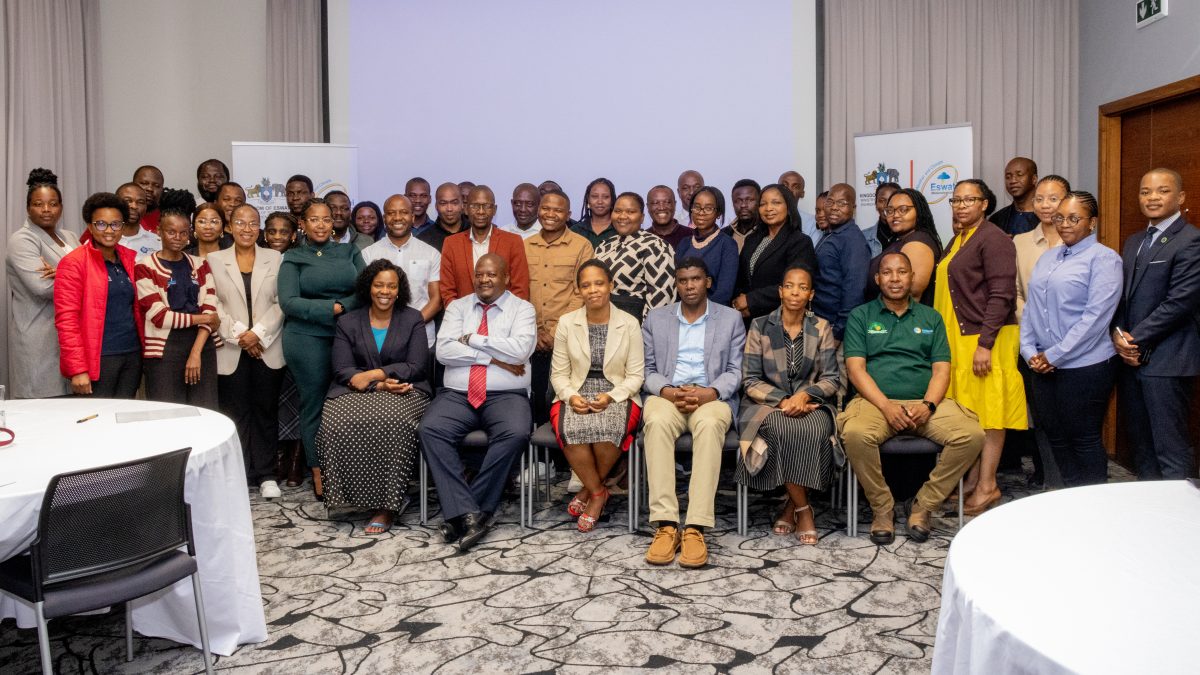


The Eswatini Economic Policy Analysis and Research Centre (ESEPARC), in collaboration with the Ministry of Tourism and Environmental Affairs (MTEA) through the Department of Meteorology Services, facilitated a two-day Stakeholder Workshop at the Hilton Garden Inn Hotel, Mbabane, from 16 to 17 October 2025 to validate the NAP 2025-2035 national targets.
Eswatini’s NAP process is informed by the framework established under the Cancún Adaptation Framework (CAF) and formalised through Decision 5/CP.17 of the UNFCCC. Setting National Adaptation targets aligns Eswatini NAP with the Paris Agreement and the Global Goal on Adaptation (GGA). These global targets provide a framework useful in ensuring that all key sectors identified under the Convention and the Paris Agreement are adequately addressed beginning at country level.
The workshop is part of the ongoing National Adaptation Plan (NAP) development process, supported by the Green Climate Fund (GCF) through the United Nations Environment Programme (UNEP). This support has strengthened national efforts to establish a coherent adaptation framework that is both nationally owned and globally aligned. The overarching purpose of the NAP process in is two-fold:
- To reduce vulnerability to climate change by building adaptive capacity and resilience.
- To integrate climate change adaptation into development planning across sectors and levels of governance.
The NAP process seeks to create an enabling environment for long-term, inclusive, and transformative adaptation that safeguards national development gains while preparing the country for emerging climate risks.
Opening Remarks
The workshop was officially opened by Ms. Duduzile Nhlengetfwa, Director of the Department of Meteorology Services. In her address, Ms. Nhlengetfwa provided a brief overview of the NAP process and expressed appreciation to stakeholders and consultants for their continued support. She highlighted current limitations in climate data and emphasised the importance of collective efforts to ensure that adaptation planning is evidence-based, inclusive, and actionable.
Workshop Objectives and Participation
The workshop convened stakeholders from the Agriculture and Food Security sector, Water sector, Health and WASH sector, Biodiversity and Ecosystems sector, infrastructure and human Settlements sector, Energy sector, including other strategic sectors such as the Gender Equity and Social Inclusion (GESI) to inform planning for women, youth and children, people with disabilities. Other considerations of the planning process are the use of indigenous knowledge, traditional and cultural heritage issues for a more country contextual planning. The diversity of participants highlighted the cross-sectoral nature of climate adaptation and the necessity of a coordinated, whole-of-government, and whole-of-society approach. Most importantly the planners convened in the workshop underscored the need for informed decision making, the need for transparency and accountability in the national climate response agenda.
Key objectives of the workshop included:
- Validating detailed the National Adaptation cost report for prioritized adaptation options across sectors.
- Reviewing findings from the Information Gap Analysis to improve data availability, reliability, accountability and transparency.
- Presenting the NAP Implementation Framework and the Monitoring, Evaluation, Accountability and Learning (MEAL) Framework.
- Strengthening stakeholder capacity in their understanding of Climate Change adaptation process and the use of relevant planning tools such as the target setting and validating tools.
The participatory approach ensured that government institutions, sector experts, development partners, and civil society contributed to shaping technically sound, socially inclusive, and financially feasible adaptation interventions.
Presentations by Local Consultant (ESEPARC) and International Consultant (OIKO)
Presentation 1: Adaptation Option Cost Estimates by ESEPARC
Mr. Gcina Dlamini, Research Fellow at ESEPARC, presented a comprehensive overview of the sectoral prioritized adaptation option costs. He revealed that the full implementation of all priority adaptation options under the NAP would cost approximately E23.1 billion, aimed at building climate resilience across six key sectors.
Mr. Dlamini highlighted that the costing methodology aligns adaptation interventions with relevant national policies and strategies. The process involved:
- Identifying and describing adaptation options in detail through stakeholder engagement.
- Mapping options to relevant institutions and data sources.
- Collecting and classifying adaptation costing data using appropriate tools.
- Conducting a Gap Analysis to review national and sectoral policies, assess the scalability and reliability of existing cost information, and document gaps restricting credible cost estimation.
Mr. Dlamini emphasized the need to address these data and capacity gaps to improve planning accuracy and strengthen the credibility of cost estimates.
Presentation 2: Cost-Benefit Analysis – International Consultant (OIKO)
An important session was delivered by OIKO, an international consultant, who presented a Cost-Benefit Analysis (CBA) highlighting the financial implications of investing in climate adaptation versus the cost of inaction. The analysis demonstrated that strategic investments in sectors like agriculture can significantly reduce long-term costs associated with climate impacts.
The CBA also highlighted that the most substantial benefits come from creating and implementing an agriculture knowledge management system, which enhances decision-making, resource allocation, and resilience across the sector. OIKO’s insights reinforced the need for evidence-based investment planning and multi-sectoral coordination to maximize both social and economic outcomes.
Presentation 3: Overview of the NAP Implementation Plan and MEAL Framework
Ms. Hlobisile Motsa, Research Consultant at ESEPARC, presented the NAP Implementation Framework and the Monitoring, Evaluation, Accountability and Learning (MEAL) Framework. She emphasized that the Implementation Framework defines sectoral interventions, while the MEAL Framework monitors progress and measures results through SMART indicators, ensuring accountability, transparency and continuous learning.
Ms. Motsa also stressed cross-sectoral actions, strategic and systematic actions essential for enhancing adaptation efforts. She highlighted that actions include amongst others: (1) Institutional strengthening (2) Capacity Building (3) Finance Resource Mobilization (4) Policy reform (5) Communication and Awareness Raising, Disaster Risk Reduction, Technology deployment and others. She added that the integration of Gender Equity and Social Inclusion (GESI), committing to inclusive representation in climate governance bodies by 2035, with at least 30% increase in youth participation in decision-making processes, 20% women and people with disabilities.
Day 2: Interactive Stakeholder Validation
The second day focused on hands-on validation of the MEAL Framework. Stakeholders used sector-specific tools developed by ESEPARC to assess SMART targets, review sectoral interventions, and propose refinements aligned with national priorities. The interactive sessions enhanced understanding of the link between implementation and monitoring, promoted ownership, and identified data gaps requiring further technical support.
Key Outcomes
- Validation of priority adaptation interventions and associated cost estimates.
- Strengthened stakeholder ownership of the NAP MEAL Framework.
- Identification of persistent data and capacity gaps across sectors.
- Consensus on a roadmap for finalizing the Implementation Plan and MEAL Framework.
Conclusion
The Stakeholder Workshop marked a critical milestone in Eswatini’s NAP process. Through multi-sectoral collaboration, evidence-based planning, and participatory decision-making, the country is building the foundation for climate-resilient development, ensuring adaptation interventions are technically sound, socially inclusive, and financially sustainable. The insights from both ESEPARC and international partners (OIKO), alike underscore the value of strategic investment, particularly in agriculture and knowledge management systems, to reduce costs and maximize adaptation benefits.
